May 24, 2026 • Callum Dray • 9 min reading time • Prices verified June 6, 2026
Kangaroo and Cattle Leather: Which Aussie-Made Bush Hat Earns Its Price Over a Decade
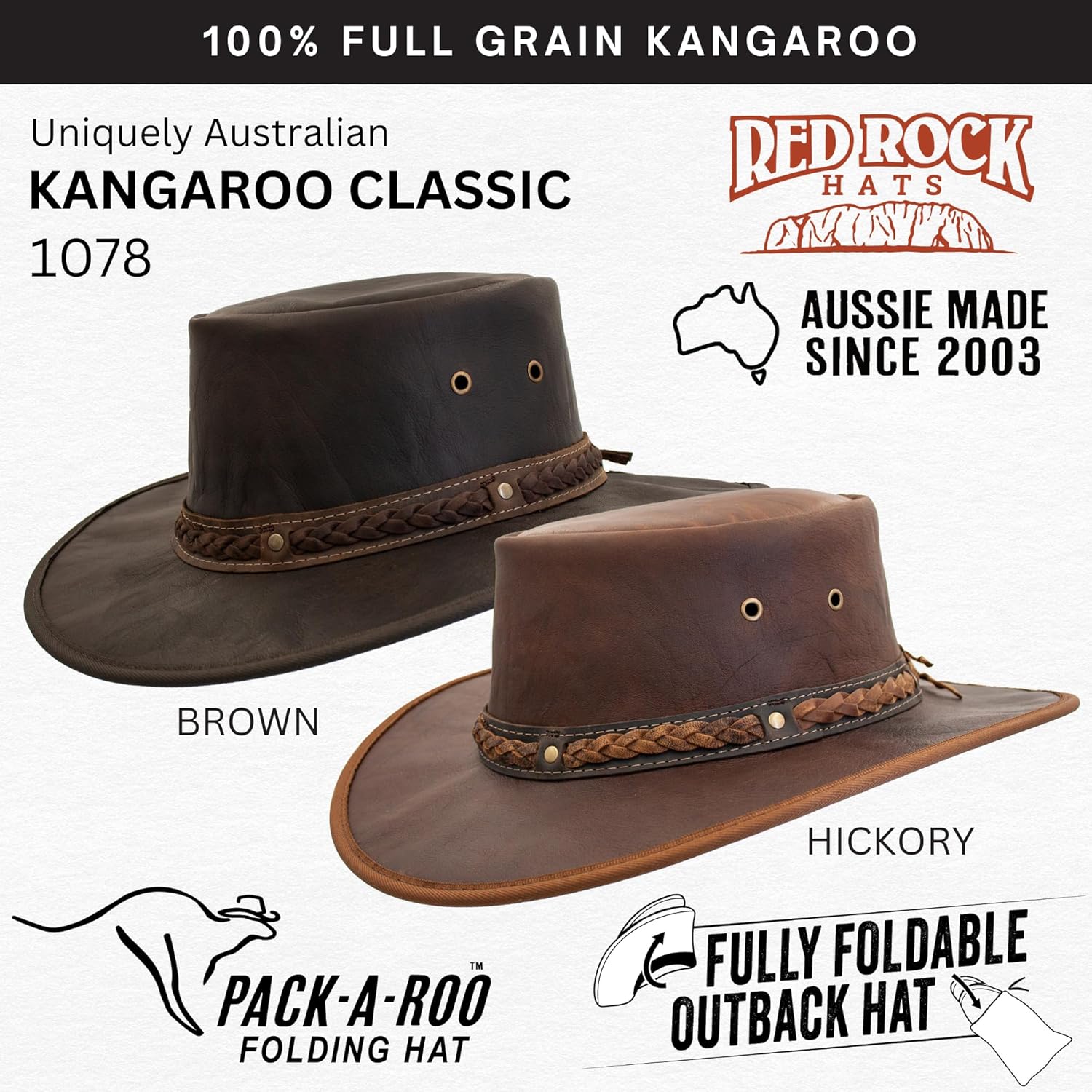
If you’ve ever picked up a leather-banded bush hat and wondered whether the trim around the crown is doing anything beyond looking the part, you’re already asking the right question. But this guide goes a step further — because a growing number of Australian hat makers now offer hat bodies crafted partly or wholly from leather, sitting alongside the fur-felt and wool-felt styles the category is known for. Leather in this context means the tanned hide used to shape or panel a hat’s crown and brim: kangaroo hide (sometimes called roo leather), which comes from Australia’s most abundant large marsupial, and cattle hide (often labelled cowhide or bovine leather), the same material behind most work boots and saddlery. Both appear in the $80–$300 tier of the Australian bush hat market, and both are marketed using nearly identical language about toughness and longevity. This article unpacks what published specs and long-run owner reviews actually tell us about how each material performs across a decade of outdoor use — and gives you a clear decision framework before you commit.
| EDITOR'S PICK[American Hat Makers Hollywood O…](https://www.amazon.com/dp/B0748L8VR9?tag=greenflower20-20) | Mid-tier1078 Kangaroo Classic - Austral… | Budget pick[Leather Down Under HAT Aussie B…](https://www.amazon.com/dp/B01H7K473G?tag=greenflower20-20) | |
|---|---|---|---|
| Leather Type | Oiled Leather | Kangaroo | Leather |
| Country of Origin | — | Aussie Made | — |
| Foldable | — | Yes | — |
| Travel Bag | — | Free Travel Bag | — |
| Sizes Available | Medium | Large | X-Large |
| Price | $139.00 | $125.00 | $47.99 |
| See on Amazon → | See on Amazon → | See on Amazon → |
Why Leather Hat Bodies Exist in a Fur-Felt World
The short answer is function. A fur-felt Akubra — made from compressed rabbit or hare fur — is peerless for shape retention, breathability, and that characteristic soft-yet-structured silhouette that Australian hatters have refined since the 1870s. But felt has limits: prolonged saturation in heavy rain can distort a brim, sweat works on the hat band over time, and felt doesn’t carry the same tactile ruggedness that some buyers working in wet or heavily vegetated environments want.
Leather hat bodies occupy a specific niche between felt and synthetic drover styles. They’re heavier, stiffer, and less breathable than fur-felt, but they shed surface water effectively, resist abrasion better in dense scrub, and develop a patina — a surface sheen and character that deepens with use — that many long-term owners describe as the hat becoming more personally theirs over time. That patina dynamic is where the kangaroo-versus-cattle conversation gets genuinely interesting, and where the decade-scale cost math starts to diverge.
Kangaroo Leather: The Performance Case
Kangaroo hide has an unusual structural advantage. As Heddels’ anatomy-of-leather guide notes, roo hide has a more uniform fibre distribution than bovine leather — the fibres run at a consistent angle across the full thickness of the skin, rather than in the layered, variable-density structure typical of cattle hide. In practical terms, this means kangaroo leather achieves high tensile strength at lower thickness. A kangaroo leather panel in a hat crown can be meaningfully thinner than an equivalent cattle panel while offering comparable tear resistance.
For hat construction, that thinness matters in two ways. First, it keeps weight down — owners of kangaroo leather drover styles consistently report that the hat doesn’t feel significantly heavier than a mid-weight wool felt after break-in. Second, thinner leather drapes and conforms more readily to the crown’s shaping block, which is how a hatter achieves those clean brim rolls and telescope crowns (a crown shape with a flat top and vertical sides, like an inverted cylinder) that distinguish premium work from production-line output.
The practical tradeoff is moisture behaviour. Kangaroo leather is less forgiving of total immersion than a well-oiled cattle hide; owners in high-rainfall station environments report that without regular conditioning — typically a lanolin-based product applied every three to four months — roo leather can dry-crack along brim edges faster than bovine alternatives. This is a maintenance commitment, not a fatal flaw, but it’s one that buyers in Far North Queensland or the Kimberley should price in honestly.
Cattle Hide: The Workhorse Case
Bovine leather is the material underneath most of the world’s leather goods for a reason: it’s thick, moderately forgiving of neglect, and widely available in grades from full-grain (the outermost layer of the hide, with the natural surface intact) to split leather (a lower layer, less durable, often used in budget goods). In Australian bush hats, the grade distinction matters considerably.
As Outside Online’s guide to evaluating leather quality before purchase notes, full-grain bovine leather is the only grade that develops a genuine patina over time; corrected-grain and split leathers tend to peel or scuff rather than age gracefully. When you’re looking at a $120–$180 cattle leather hat from makers like Kakadu Traders or RM Williams’ hat accessories range, the first question worth asking is whether the product description specifies full-grain. If it says only “genuine leather” without qualification, that’s typically a signal that the hide is a corrected or split grade — functional for a few seasons, but unlikely to reach the decade-mark in good condition.
Full-grain cattle leather, properly maintained, is the more forgiving long-distance runner. Owners of full-grain bovine drover hats in aggregated forum reviews consistently describe hats that survived ten-plus years of station use with re-stitching and periodic conditioning as the only interventions. The brim holds its geometry — the pencil curl (a tightly rolled brim edge, shaped over a mandrel during manufacture) tends to relax into a softer roll on bovine leather over time, which some owners prefer and others find disappointing. If you want a brim that holds its original sharp geometry for a decade, kangaroo leather’s structural consistency has the edge. If you want a brim that softens into a working character, full-grain bovine is your material.
The Decade Cost Math: By the Numbers
Before getting to the decision framework, it helps to lay the price and maintenance reality side by side.
At a glance (May 2026 retail, AUD):
| Variable | Kangaroo Leather Hat | Full-Grain Cattle Hat |
|---|---|---|
| Entry price (quality mid-range) | $180–$260 | $120–$180 |
| Conditioning product per year | ~$25–$35 | ~$15–$25 |
| Likely re-block or re-stitch (decade) | 1× (~$60–$90) | 1–2× (~$60–$180) |
| Estimated 10-year all-in cost | $510–$700 | $330–$610 |
The ranges overlap, which is the honest finding: a well-maintained full-grain bovine hat can approach the decade-cost of a kangaroo leather hat if it needs two re-stitches, but on average the cattle option is cheaper across ten years. The kangaroo option earns its premium in weight-to-durability ratio, shape retention, and brim geometry consistency — not in raw cost savings.
Country Life’s buyer guidance on long-life hats makes a point worth repeating here: the single biggest predictor of whether a hat reaches its decade in good condition is consistent, simple maintenance — not the material’s theoretical ceiling. A neglected kangaroo leather hat will fail before a conscientiously maintained full-grain bovine one.
What Australian Manufacturing Heritage Actually Signals
This is where provenance earns its editorial weight, and where the “Aussie-made” label does meaningful work beyond marketing.
Australian Geographic has documented the country’s leather goods tradition as closely tied to the pastoral industry — hides processed in Queensland and New South Wales tanneries, often using traditional vegetable tanning methods (where the hide is treated with plant-derived tannins rather than chromium salts) that produce a stiffer, more structured result than chrome-tanned alternatives. Vegetable-tanned leather is the preferred substrate for serious hat bodies because it holds blocking — the process where a hatter uses steam and a wooden form to shape the crown and brim — more permanently. Chrome-tanned leather, which dominates global production for cost reasons, softens more readily under heat and can lose its blocked shape in a hot car or direct sun.
When a hat is described as made in Australia from Australian-sourced leather, it often (though not always — ask the retailer directly) implies vegetable tanning, because the surviving Australian tanneries predominantly use traditional methods. This isn’t guaranteed, and the honest answer is that not every maker is transparent about their tanning process. But it’s a question worth putting directly to any retailer before buying at the $200-plus level: “Is this vegetable-tanned or chrome-tanned?” A confident, specific answer is itself a quality signal.
The cultural lineage also matters for resale and restoration. Hats from makers with established Australian networks — like Jacaru’s domestic production line or pieces from named Sydney or Melbourne milliners — are more likely to have access to re-blocking services and matching leather sourcing if a repair is needed in year eight. Grey-market imports that use “Australian style” language but offshore manufacturing typically lack that aftermarket support, which erodes the decade-scale value proposition significantly.
The Decision Framework: If X, Then Y
By now the comparison has enough resolution to make direct calls. Here’s where the logic settles:
If you work in a wet, high-abrasion environment (dense coastal scrub, wet-season cattle work, equestrian pursuits in variable weather) and you’re willing to condition every three months: kangaroo leather, in a quality mid-range piece from a named Australian maker, is the correct call. The weight-to-strength ratio and superior shape retention justify the $180–$260 entry cost, and a decade of faithful conditioning keeps brim geometry intact.
If you want a hat that forgives occasional neglect and you’re prepared to accept a brim that softens gradually over time: full-grain bovine leather at the $150–$180 level is the smarter spend. It’s the more forgiving long-runner for buyers who won’t stick to a strict conditioning schedule, and the lower entry cost means you’re not over-committed if the hat shape isn’t quite right after the first season.
If you’re at the $80–$120 price point and the description says only “genuine leather” without specifying full-grain: treat this as a short-to-medium-term hat (three to five seasons) and budget accordingly. There’s nothing dishonest about that purchase at that price — but don’t project decade-scale expectations onto a split-grain product.
If the provenance is unclear — no named tannery, no tanning method specified, no Australian manufacturing confirmation — factor in the absence of aftermarket support. A hat you can’t get re-blocked locally in year seven is a hat that effectively ends its life at the first major structural failure.
The decade-scale question always comes back to the same variable: what is the realistic maintenance commitment you’ll actually keep? Match the material to that honest answer, not to the aspirational one. The best leather hat you’ll own is the one that fits your maintenance habits as well as it fits your head.