May 13, 2026 • Callum Dray • 9 min reading time • Prices verified June 6, 2026
Sizing Accuracy and Oval Fit: How to Buy an Australian Bush Hat Online Without Getting It Wrong
Buying any hat online carries a certain leap of faith. Buying a $250–$400 hand-crafted Australian bush hat online — something hand-blocked from fur-felt (fur-felt means the hat body is made from compressed animal fur, usually rabbit, processed into a dense, water-resistant material rather than woven fabric) — requires a little more discipline. The problem isn’t that online hat buying is unusually risky; it’s that most buyers underestimate one variable: oval fit. Your hat size, measured as the circumference of your head in centimetres, tells a maker how big your head is. It says almost nothing about its shape. And shape — how much longer your head is from front to back compared to side to side — is what determines whether a hat sits flush on your head or rocks, pinches, or gaps at the temples. This article walks through how to measure correctly, how to decode maker sizing conventions, and how to make a confident online purchase with a clear return-or-alter fallback if the first fit isn’t right.
The Two Numbers You Actually Need Before You Buy
Most hat guides stop at circumference, which is a mistake. Here is what you genuinely need to know before clicking purchase.
Circumference is measured by wrapping a soft tape measure (or a strip of paper you then measure flat) around your head, roughly 2–3 cm above your ears, at the point where a hat’s inner sweatband would sit. Measure at least twice. Round up to the nearest half-centimetre. This gives you your nominal hat size, which converts directly to the European metric system used by Akubra, Barmah, and most Australian makers (56, 57, 58, 59, and so on in centimetres).
Oval ratio is the one most buyers skip. Measure the front-to-back length of your head (forehead to the back of the skull, above the ears) and the side-to-side width (ear to ear across the widest point). A head where the front-to-back measurement is notably longer than the side-to-side measurement is described as long oval or narrow oval. A head where those measurements are close to equal is round oval. A head where side-to-side slightly exceeds front-to-back is wide oval. The heddels.com guide on hat sizing at home describes this ratio as the single most overlooked variable in online hat purchasing — and owners across premium Akubra reviews consistently echo that complaint after an otherwise correctly sized hat arrives and perches rather than sits.
By the Numbers
| Head oval type | Front-to-back vs. side-to-side difference | Common result if unaddressed |
|---|---|---|
| Round oval | < 5 mm difference | Most stock hats fit well |
| Long oval | 10–20 mm longer front-to-back | Hat rocks side-to-side; gaps at temples |
| Wide oval | 10 mm+ wider side-to-side | Hat sits high; front and back pinch |
The majority of stock Australian bush hats — including Akubra’s standard production runs — are blocked on what the industry calls a medium oval or regular oval block, which approximates the statistical average of the Australian male head. If you’re close to that average, circumference alone will get you a good fit. If you’re not, knowing your oval type before you order is the difference between a hat that works and one that goes back.
How Australian Makers Handle Sizing — and Where They Differ
This is where intermediate buyers often get tripped up: different makers use the same nominal centimetre sizes but block their hats on subtly different lasts (the hat-shaped wooden or aluminium forms around which felt is shaped), and their internal measurements can vary by a half-size or more even when the label says the same number.
Akubra sizes run true to their published centimetre measurements in most reviewers’ experience. The Akubra official sizing guide notes that their hats are blocked to a standard oval, and the company recommends ordering your exact measured circumference rather than sizing up. Owners of the Akubra Snowy River and Stockman models consistently report that the sweatband — a leather inner band that sits against your forehead and absorbs sweat while anchoring the hat — breaks in and expands slightly over the first dozen wears, so a new hat that feels snug but not painful at purchase will typically settle to a comfortable fit within a season.
Barmah Hats, whose shaping system uses a different last from Akubra’s, skews slightly larger in practice. The Barmah sizing FAQ notes this explicitly, recommending that buyers between two sizes order the smaller size. This is important because Barmah’s crushable hats (hats designed to be rolled or folded without permanent damage to the crown shape, using more flexible felt or canvas) are more forgiving of minor oval mismatch than a rigid Akubra fur-felt — but they still need to be close.
Jacaru and Kakadu Traders use Australian/metric sizing but their products are predominantly mid-range wool-felt or oilskin drover styles (the oilskin drover being a wide-brimmed, waxed-cotton or synthetic-waxed hat associated with stockman culture — built for weather resistance more than fine blocking). Owner reports across outdoor retail review threads note that Jacaru sizing is consistent but the oval tends to run slightly wider than Akubra’s standard block, making Jacaru a reasonable fit for wide-oval heads who struggle with standard Akubra sizing.
Bespoke Australian milliners — independent hatmakers offering custom-blocked pieces — will ask for both measurements and often a paper template (you trace the inside of a well-fitting hat or use a cardboard strip shaped to your head). At the $350–$600+ price point, this is the right approach and removes the oval-fit guesswork entirely.
The Country Life hat-fit guide, which addresses European and Australian riding hats using similar fur-felt construction, notes that the break-in arc for quality fur-felt is real and should be factored into sizing decisions: a hat that is genuinely one size too large will never tighten; a hat that is half a size snug will almost always ease to fit.
Online Purchase Strategy: De-Risking the Decision
If you know your circumference and your oval type, buying online becomes manageable. Here is the decision framework that experienced buyers and specialist hat retailers consistently recommend.
Step one: confirm the retailer’s return and exchange policy before you pay. Authorised retailers for Akubra and Barmah generally offer exchange on unworn hats. Hats that have been worn — even briefly outdoors — typically cannot be exchanged. This means you need to do your fit assessment indoors, on clean hair, before committing. Note that grey-market sellers and non-authorised retailers often have no exchange policy at all, which is a material risk at the $200–$400 price point. The Australian Geographic’s profile of Akubra’s retail ecosystem notes that the brand’s authorised retailer network maintains consistent quality control and warranty support that grey-market channels do not.
Step two: match your oval type to the maker’s block. If you are round oval, any of the major makers will work — go by circumference. If you are long oval and buying Akubra, consider contacting the maker or an authorised specialist retailer directly; some carry long-oval blocked versions of popular models, or can arrange blocking adjustments. If you are wide oval, the Jacaru range or a bespoke piece is your lower-friction path.
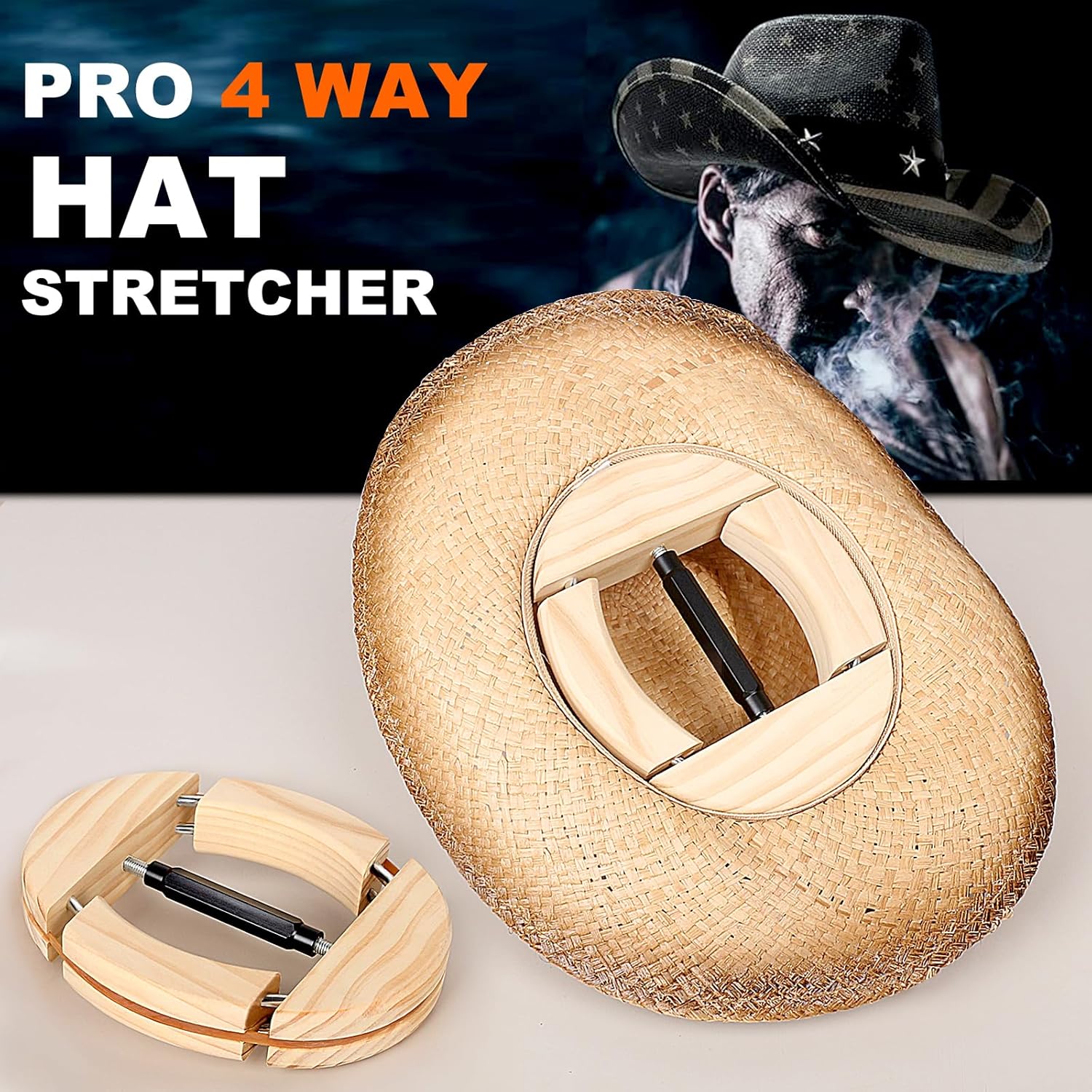
Step three: understand what can be adjusted after purchase and what cannot. A hat that is half a size too large can be reduced with a foam or leather sweatband insert — a cheap and reversible fix. A hat that is a full size too large cannot be reliably corrected at home. A hat that is too small can sometimes be stretched by a professional hatter (using steam and a stretching device), but fur-felt has limits and over-stretching degrades the hat’s structure. Brim geometry — the angle and width of the brim, and the shape of the crown — cannot be corrected at home without specialist tools and skill.
Step four: use the pugaree as a minor fit buffer, not a primary fix. A pugaree (pronounced pug-uh-ree) is the fabric or ribbon band wrapped around the outside of the crown just above the brim — it’s a functional and decorative element with roots in colonial-era military and bush headwear. A slightly thicker pugaree will reduce internal crown volume marginally, but this is a cosmetic adjustment, not a structural one. Don’t rely on it to solve a genuine sizing problem.
The Decision Rules
You’ve done the measuring. You know your oval type. Here is the clean if/then framework:
If you are round oval and within the maker’s standard size range — order your exact circumference in any of the major makers’ standard production lines. The sweatband will handle minor variation. Fur-felt will handle the rest.
If you are long oval — contact the retailer before ordering and ask specifically whether the model you want is available on a long-oval block. If not, ask about professional hat-stretching services post-purchase, or move toward a bespoke option if budget allows.
If you are wide oval — Jacaru’s slightly wider block is worth trialling at the mid-range tier. At the premium tier, a custom-blocked Akubra or bespoke milliner piece is the right answer and worth the premium over the cost of exchanging a standard-block hat twice.
If you are between sizes — buy down (smaller) for fur-felt hats that will break in; buy up (larger) for crushable wool-felt or canvas styles that will not. This is the consistent recommendation in Barmah’s own sizing documentation and echoed in aggregated owner reviews of both brands.
If the retailer has no exchange policy — walk away unless you have had the specific model on your head in a physical store first. A $300 hat bought from an unverifiable seller with no return path is a $300 gamble, not a considered purchase.
The considered hat buyer — the reader this site is built around — is not someone who buys impulsively and hopes for the best. They are someone who does the measuring, asks the right questions, and commits once. Get your two numbers right, match them to the maker’s block, confirm your exchange window, and the rest is straightforward.