April 29, 2026 • Callum Dray • 9 min reading time • Prices verified June 6, 2026
When Mid-Range Is Enough: Canvas, Cotton, and Oilskin Bush Hats for the Practical Outdoors Buyer
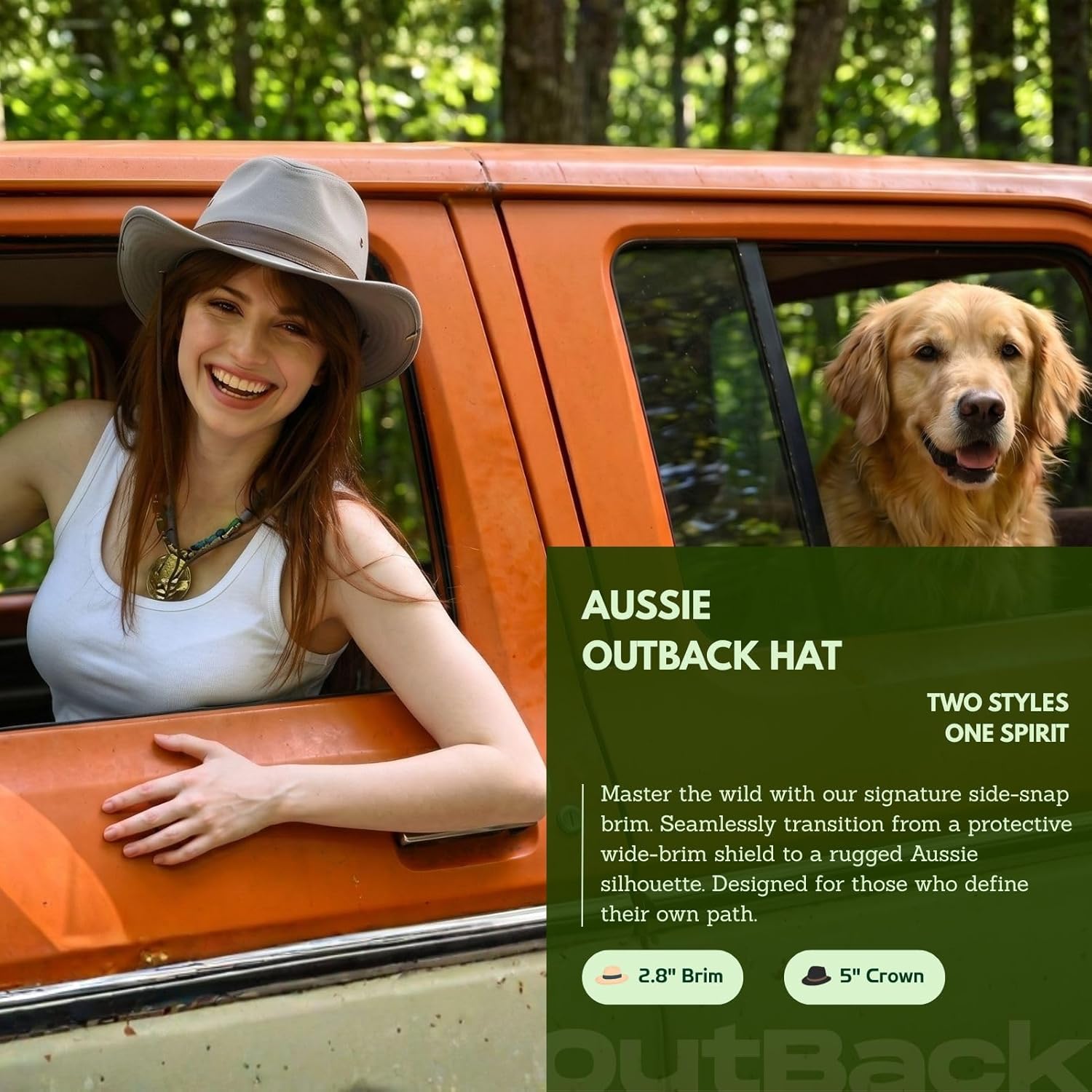
If you’ve started looking at bush hats seriously, you’ve probably already noticed the price ladder can feel a little vertiginous: a Barmah canvas drover at $55, a Kakadu Traders oilskin at $110, an RM Williams wool-felt at $150, and then a hand-blocked Akubra fur-felt somewhere north of $280. The gap between tiers raises a reasonable question — one that doesn’t get asked nearly enough — do I actually need to climb higher, or is the mid-range genuinely good enough for what I’m doing? This guide is for the buyer who has moved past “which hat looks right” and is now asking “which hat performs right, for the specific conditions I’ll be in.” We’ll look at the three most common mid-range materials — canvas, cotton, and oilskin (a tightly woven fabric impregnated with a wax or oil finish to make it water-resistant) — and lay out an honest, tradeoff-explicit framework for deciding when they earn their keep and when they’re a stepping stone.
| EDITOR'S PICK[Outback Trading Company Unisex](https://www.amazon.com/dp/B004BQ5ZRW?tag=greenflower20-20)… | Mid-tier[Dorfman Hat Co. - Saguaro](https://www.amazon.com/dp/B001GK0EZY?tag=greenflower20-20) -Men’… | Budget pickDorfman Hat Co. Weathered Outba… | |
|---|---|---|---|
| Material | Cotton oilskin | Twill | — |
| UPF Rating | 50 | 50+ | — |
| Waterproof | ✓ | — | — |
| Chin Cord | — | — | ✓ |
| Price | $79.99 | $44.99 | $43.99 |
| See on Amazon → | See on Amazon → | See on Amazon → |
What These Materials Actually Are (and What They’re Not)
Let’s establish the vocabulary before we start comparing, because the terms get used loosely even by retailers.
Canvas in a hat context usually means a tightly woven cotton duck or cotton-polyester blend — heavier than a shirt fabric, lighter than sailcloth. Barmah’s iconic Foldaway and Squashy ranges use a cotton canvas that can be rolled, stuffed in a pack, and shaken back into shape. That crushability is the whole value proposition. The trade-off is that uncoated canvas absorbs moisture rather than shedding it; in sustained rain, you’ll feel it.
Cotton drill and ripstop cotton appear in Jacaru and Kakadu Traders lines, often in the $55–$90 bracket. Drill is a diagonal-weave cotton that’s more abrasion-resistant than standard canvas; ripstop adds a reinforcing grid thread to prevent tears from propagating. Neither is inherently waterproof — both typically rely on a Durable Water Repellent (DWR) chemical treatment applied at the factory, which is effective new but degrades with UV exposure and washing. Owners of Jacaru’s cotton range consistently report that re-proofing with a spray-on DWR treatment every season or two restores most of the original shed performance.
Oilskin is the most technically capable of the three for wet conditions. The term covers a family of wax-impregnated fabrics — traditionally linseed-oil-treated cotton, now more often paraffin or synthetic wax on a cotton base. Country Life’s overview of waxed cotton notes that a quality oilskin “will last decades with periodic re-waxing, developing a patina that breaks in like leather rather than breaking down.” Kakadu Traders’ Jackaroo and similar oilskin styles sit in the $90–$130 range and use a medium-weight cotton base (typically around 8–10 oz.) with a factory wax finish. They are the rain-day workhorse of the mid-range tier.
What none of these materials do is match fur felt for thermoregulation and decade-long shape retention under heavy wear. That’s not a criticism — it’s just the honest constraint the mid-range buyer needs to keep in their decision model.
By the Numbers
| Material | Typical Price Range | Rain Resistance (out of box) | Crushable? | Re-conditioning Required? |
|---|---|---|---|---|
| Canvas (Barmah Foldaway style) | $55–$85 | Low–moderate (DWR fade) | Yes | DWR re-spray annually |
| Cotton drill / ripstop (Jacaru) | $65–$110 | Moderate (DWR) | Partial | DWR re-spray 1–2×/year |
| Oilskin (Kakadu Traders, Jacaru) | $90–$150 | High | No | Re-wax every 1–3 seasons |
The Decision Frame: Three Use Profiles That Tell You Which Tier to Buy
The mid-range question isn’t really about budget tolerance — it’s about use-case fit. Here are the three profiles that recur most clearly across owner reports and outdoor gear publications.
Profile 1: The High-UV, Low-Rain Outdoors User
If your primary enemy is the Australian sun — station work, long-haul driving, equestrian, hiking in arid country — and you’re not regularly caught in sustained downpours, canvas and cotton drill are genuinely strong choices. The key spec to interrogate here is brim width. A narrow brim (say, 2.5 inches / 6 cm) gives you minimal shade on your ears and neck. For serious UV exposure, you want 3.5 inches (9 cm) or more — what the industry calls a Territory-style or Drover-style brim.
Outside Online’s coverage of sun hats for outdoor use consistently flags brim geometry — specifically the combination of brim width and a stiffened or wired brim edge — as the dominant variable in neck and ear protection, ahead of material choice. A Barmah canvas Foldaway with a wired 3.5-inch brim and a UPF 50+ rating on the fabric delivers meaningful sun coverage. Owners who use the Foldaway for long outdoor days in Queensland and the NT report it holds its wired shape well and the crown (the domed or structured top of the hat) doesn’t collapse in heat.
If X = primarily sun, minimal sustained rain: Canvas or cotton drill at $65–$110 is the right call. Spend the savings on a quality chinstrap — the most under-specified component in wind-heavy environments, and often absent from entry-level configurations.
Profile 2: The Mixed-Conditions Working Buyer
This is where oilskin earns its premium over basic canvas. If you’re moving between outdoor tasks in a climate that delivers genuine weather — South Australian winter, highland Victoria, tropical wet-season work in the Top End — the ability to stay dry for an extended ride or a full work day without constantly pulling out a separate rain cover is worth the $40–$60 step up over cotton.
Heddels’ material guide on waxed cotton and oilskin notes that a properly maintained oilskin sheds moderate rain “almost indefinitely, whereas DWR-coated synthetics degrade measurably within two years of regular use.” The maintenance ask is real: re-waxing with a product like Otterwax or the maker’s own wax kit (Kakadu Traders includes guidance with their oilskin range) takes about twenty minutes, and owners report doing it every one to three seasons depending on intensity of use. Factor that into your cost-of-ownership model.
The shape trade-off with oilskin is worth naming explicitly: most oilskin hats have a stiffer, structured brim that doesn’t fold or crush. That’s a feature for a working context — a snapped brim edge (stiffened so one side can be turned up or pinned, the “snap” being the fastening mechanism) holds its position. It’s a friction point if you’re also using the hat for travel and need it to pack flat.
If X = mixed weather, working outdoors, need genuine rain shed: Oilskin in the $90–$150 range is the tier that earns its keep. Kakadu Traders’ Jackaroo and Squatter styles, and Jacaru’s oilskin range, are the most cited options in this segment by Australian outdoor and station-supply reviewers.
Profile 3: The Style-Forward Traveller Who Wants Authentic Australiana
There’s a third buyer who reads differently from the first two: someone who wants the cultural legitimacy of a genuine bush hat — the wide-brimmed silhouette, the leather puggaree (the decorative band around the crown, traditionally wound from cloth or leather and historically used for ventilation and to hold hat pins) — but whose primary “outdoor” use is urban travel, occasional hiking, and photography. For this reader, canvas is a very defensible choice, and the crushability argument becomes primary.
Australian Geographic’s profile of Australian hat-making heritage notes that the Barmah Foldaway “became a genuine export phenomenon in the 1990s precisely because it survived suitcase packing in a way that felt hats could not.” That story is still true in 2026. A $65 Barmah canvas hat that survives a six-week trip through Central Australia and still holds its shape is delivering genuine value that a $320 felt hat — which requires a hat box or careful packing — can’t always match in the same context.
The honest caveat: canvas hats at this tier are not investment pieces. Owners typically report 3–5 years of active use before the cotton begins to show UV degradation and the DWR finish becomes difficult to restore. That’s not a failure — it’s the correct expectation for the price point. If you find yourself reaching for a canvas hat every single day for five years and thinking “I wish this was built to last 20,” that’s the signal you’ve outgrown the tier and should be looking at the Akubra or a premium wool felt.
What Mid-Range Gets Right That Premium Doesn’t Always Match
It’s worth being direct about the areas where the $80–$150 tier is genuinely superior to fur felt, not just “good enough.”
Washability. Fur felt is dry-clean only in any serious sense; getting it wet in the wrong way and then letting it dry without reshaping can permanently alter the crown geometry. Most canvas and cotton hats can be hand-washed with cold water and air-dried without drama. Owners who work in environments where a hat gets genuinely dirty — red dirt, animal contact, heavy sweat — consistently rate washability as a top practical feature.
UV-specific fabrics. Several mid-range makers build their cotton canvas from fabric with a certified UPF 50+ rating — meaning the fabric itself blocks over 97% of UV radiation, independent of any coating. Fur felt is effective at UV blocking through mass and density, but formal UPF certification is less commonly published for felt hats. For buyers who are specifically thinking about skin cancer prevention across years of daily outdoor use, certified UPF fabric is a meaningful spec.
Weight. A well-constructed canvas or cotton hat typically comes in at 80–140 grams. Fur felt at a comparable quality level runs 100–180 grams. The difference sounds trivial, but owners who wear a hat eight-plus hours a day in heat consistently report noticing it by mid-afternoon.
The Clear “If X, Then Y” Decision Rules
Rather than hedging into a vague “it depends,” here’s the decision model as plainly as we can state it:
-
If your conditions are primarily sun, rarely sustained rain, and you value packability: Canvas or cotton drill, $65–$110, is the right tier. Don’t overspend.
-
If you work outdoors in genuinely mixed weather and need reliable rain shed for hours at a time: Oilskin, $90–$150. The maintenance is real; budget 20 minutes and the cost of a wax kit every couple of seasons.
-
If you’re buying primarily for travel or occasional outdoor use and want authentic Australian design: Canvas crushable, $55–$85. Set the expectation at 3–5 years of active use, not 20.
-
If you’re wearing a hat daily in demanding outdoor conditions and have started resenting its limitations — seams softening, DWR failing, brim losing structure — after two or three years: That’s the signal to step up to the premium tier. An Akubra in pure fur felt (rabbit or hare fur, graded X through XXXXX by density and fineness) properly cared for is a documented 15–25 year piece. The math eventually tips.
The mid-range isn’t a compromise — it’s a correct answer to a specific set of questions. Know your questions, and the tier choice becomes straightforward.