April 22, 2026 • Callum Dray • 9 min reading time • Prices verified June 6, 2026
Outback Trading Company Oilskin and Wool Hats: Brim Geometry and Water Resistance Honestly Assessed
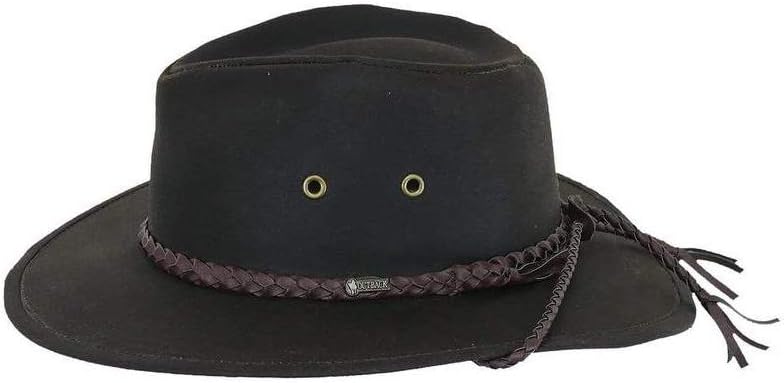
If you’ve been looking at hats for outdoor work or travel and kept landing on the name Outback Trading Company, you’re in good company — but the brand occupies a genuinely tricky spot on the market shelf. These are American-marketed hats built around an Australian bush aesthetic: oilskin (a waxed cotton fabric that sheds rain by filling its weave with an oil-based compound, rather than relying on a synthetic laminate) and wool-felt construction at a price point — typically USD $50–$120 — that sits below heritage Australian makers like Akubra but well above the department-store end of the rack. That middle position is exactly where buyers tend to second-guess themselves. This guide breaks down what the brim geometry actually does to sun protection and rain-off performance, how the oilskin treatment ages in documented owner experience, and where the wool-felt models stand against the decision to spend more or less. By the end, you’ll have a clear if-then decision rule rather than a list of adjectives.
| EDITOR'S PICKOutback Trading Company Men's 1… | Mid-tierOutback Trading Company Unisex… | Budget pickOutback Trading Company Unisex… | |
|---|---|---|---|
| Material | Wool | Cotton Oilskin | Cotton Oilskin |
| Water Resistance | Water-Resistant | Waterproof | Waterproof |
| UPF Rating | UPF 50 | UPF 50 | Sun-Protective |
| Crushable | ✓ | — | — |
| Mesh Lining | — | — | ✓ |
| Brim Style | Western Cowboy | Western | Outdoor |
| Price | $79.99 | $79.99 | $74.99 |
| See on Amazon → | See on Amazon → | See on Amazon → |
What “Oilskin” Means in Practice — and Why the Coating Weight Matters
Oilskin cloth, as Heddels’ primer on waxed and oilskin fabrics explains, is woven cotton whose interstices — the tiny gaps between threads — are saturated with a paraffin- or wax-oil blend. Water beads and runs off the surface rather than wicking through. The critical variable is coating weight: lighter treatments feel pliable and packable but begin to thin at high-friction points (hatband contact, brim edge, crown crease) within a season or two of hard use. Heavier treatments resist abrasion longer but make the fabric stiff, especially in cold weather, and contribute to that waxy smell that some owners find objectionable indoors.
Outback Trading Company’s oilskin hats — the Drover, the Pak-A-Roo, and the Aussie Too, among others — use a mid-weight cotton-canvas oilskin. The company’s own specification pages list the fabric as oilskin-finished cotton canvas without publishing a specific oz/yd² weight, which is a common omission in this price tier. What that means practically: owners across aggregated reviews consistently report solid initial water-shedding — rain beads cleanly for the first season — but note that without re-waxing (applying a solid or liquid wax restorer to the surface, which revives the oil content), performance degrades noticeably by year two. Country Life UK’s guide to country hats notes the same pattern across the oilskin category generally: “plan to re-wax annually for working use, every two to three years for occasional use.”
That’s not a criticism unique to this brand. It’s the honest maintenance contract that comes with oilskin at any price point. The decision-frame question is: are you prepared to re-wax, or do you want a hat that needs no maintenance? If the latter, a synthetic-shell or laminated hat solves the problem differently — but loses the aesthetic and the breathability that make oilskin attractive in the first place.
By the numbers — Outback Trading Company oilskin tier:
| Model | Brim Width (approx.) | Crown Height | Approx. USD (2026) |
|---|---|---|---|
| Drover | 3.5 in | Medium | $70–$85 |
| Pak-A-Roo | 3 in | Low/crushable | $55–$70 |
| Aussie Too | 3.75 in | Medium-high | $80–$100 |
| Big Brim Oilskin | 4.5 in | Medium | $90–$115 |
Brim Geometry: Where the Real Sun-Coverage Decisions Live
Outside Online’s assessment of sun hats for outdoor activity is consistent on one point: a brim width of at least 3 inches all the way around is the practical minimum for meaningful UV shading of the face, ears, and back of the neck. Below that, you’re shading your eyes but leaving your ears and the back of your neck — two high-exposure zones for people working outdoors — substantially unprotected.
Outback Trading Company’s range spans from the 3-inch Pak-A-Roo up to the 4.5-inch Big Brim, which is worth pausing on because that 1.5-inch difference is not cosmetic. A 3-inch brim on a medium-crown hat at average head height shades roughly to the jawline in midday sun; a 4.5-inch brim extends shade to the collar line and covers the ears at a shallower sun angle — early morning, late afternoon, or southern-hemisphere winter. If you’re doing station work, long-haul trail walking, or working in a high-UV environment, the geometry math consistently favours wider.
The brim profile — whether it sits flat, is angled downward (a droper or “down-swept” brim), or has an upward curl — changes both sun coverage and rain performance meaningfully. A flat brim channels rain straight off the edge; a down-swept brim directs water forward and away from the face but can funnel it onto the shoulders. Outback Trading Company’s Drover and Aussie Too models feature a mild down-sweep at the front and a slight upturn at the sides — the classic Australian working-hat silhouette that Australian Geographic’s history of bush headwear traces back to practical adaptations for riding: the upturn on the side prevented the brim from catching wind at a canter.
The stiffening in oilskin brims deserves a note. A stiffer brim holds its geometry under rain weight; a more pliable brim can droop when saturated, which both reduces sun coverage and creates a drip line directly onto the wearer’s shoulder. Owners of the Pak-A-Roo — a crushable, packable model explicitly designed for travel — consistently report some brim softening after repeated wetting and drying cycles, which is the expected tradeoff for packability. If brim rigidity over years of use is your priority, the Drover’s heavier canvas construction holds its shape better in owner reports.
One technical note worth understanding: the wire brim option on some Outback Trading Company models (a thin steel wire sewn into the brim perimeter) allows the wearer to reshape the brim manually and prevents progressive droop. This is a meaningful long-term durability feature, and it’s worth confirming whether a specific model includes it before buying, since it’s not consistently called out in all retail listings.
Wool-Felt Models: What the Wool Grade Tells You (and What It Doesn’t)
Outback Trading Company’s wool-felt line — including the Grizzly and the Open Road — sits at a different point in the performance matrix. Wool felt (pressed and matted wool fibres, shaped under heat and steam) is not inherently water-resistant the way oilskin is, but it does shed light rain reasonably well for short exposures. The felt’s lanolin content — lanolin being the natural wax secreted by sheep wool — provides some baseline moisture resistance. Heavier, denser felt (measured in X-factors in the premium Akubra system, but simply described as “weight” or “grade” at this price point) resists saturation longer and holds its crown shape better over years.
Outback Trading Company does not publish a felt weight or grade for its wool models, which is consistent with the mid-tier market but a genuine information gap for the informed buyer. What owner reports suggest, aggregated across reviews, is that the wool-felt models perform well in light rain and cool conditions but are not suited for sustained wet weather without the buyer applying a wool protector spray (a silicone- or fluoropolymer-based water repellent designed for felt). Without that treatment, heavy rain will saturate the crown and cause temporary distortion — the hat will regain most of its shape as it dries on a head-form or dome, but repeated soaking and unmanaged drying will shorten its structural life.
The honest comparison point here is against Akubra’s entry catalogue. An Akubra Stylemaster or Bronco in the AUD $180–$220 range (approximately USD $115–$140 at current rates) uses a higher-density pure hare-fur felt — a material graded and documented in Akubra’s published manufacturing standards — that resists saturation more effectively and holds its geometry under hard use for decades, as documented in owner accounts cited by Australian Geographic. That’s a genuine material difference, not a brand premium for its own sake. If you’re buying a wool-felt hat for serious outdoor work and expect it to last ten-plus years, the Akubra tier earns its price. If you’re buying for travel, occasional wear, or style, Outback Trading Company’s wool-felt models represent honest value at their price point.
Honest Longevity: What the Multi-Year Owner Picture Looks Like
Country Life UK’s hat guide notes that a well-maintained oilskin hat from a reputable manufacturer “should last a decade or more with annual re-waxing.” Owner reports for Outback Trading Company’s oilskin models — gathered across gear forums and outdoor retailer review sections — tell a more differentiated story by use intensity.
Light-use owners (occasional travel, social wear) consistently report hats that look and perform well at five years with minimal maintenance beyond re-waxing once. Hard-use owners (daily station work, extended trail use in wet climates) report meaningful wear at the brim edge, hatband area, and crown crease within two to three years, with some reporting delamination at the brim edge — a point where the oilskin canvas is folded and sewn, creating a stress concentration.
That’s not unusual for this construction tier; it’s a useful data point for calibrating expectations. The comparison point for heavy-use buyers is the oilskin market’s upper tier: RM Williams oilskin hats and Kakadu Traders’ heavier-canvas models use thicker canvas bases and more durable brim construction, typically at AUD $90–$160 (USD $58–$103). At those prices, the build is legitimately more durable for sustained hard use, per owner reports across multiple long-run reviews.
For the wool-felt models, the longevity picture is simpler: if you treat the felt seasonally with a wool protector and store the hat on a form rather than crushed, owners report good shape retention at three to five years. Beyond that, the felt’s density relative to a premium Akubra becomes the limiting factor — it compresses at pressure points (headband contact, crown crease) and doesn’t spring back the way higher-density fur-felt does.
The Decision Rule
Here’s the if-then frame this article is building toward:
If you want a rain-capable, sun-protective hat for travel, occasional outdoor use, or Australian bush aesthetics on a USD $60–$100 budget, then Outback Trading Company’s oilskin Drover or Aussie Too is a genuinely honest choice — provided you commit to re-waxing annually and choose the wire-brim version for longer brim-shape retention.
If you’re buying for daily hard outdoor use — station work, sustained wet-weather trekking, equestrian work in high-UV conditions — then the oilskin tier from Kakadu Traders or RM Williams, or the fur-felt tier from Akubra, earns the additional spend through documented multi-year durability that the Outback Trading Company construction doesn’t consistently match in owner reports.
If you want a crushable, packable oilskin for travel and are comfortable with some brim softening over time, then the Pak-A-Roo is the right call within the range — accept the tradeoff consciously rather than being surprised by it.
If the wool-felt aesthetic is what you’re after and longevity beyond five years matters, then move the budget to the Akubra entry catalogue. The felt grade difference is real and documented, not marketing abstraction.
The brand occupies a legitimate market position. What it is not is a substitute for the heritage Australian tiers when those tiers’ durability characteristics genuinely matter to your use case. Name the tradeoff, price it honestly, and the decision gets straightforward.